
What Is Next Best Action? The AI Deciding the Best Next Move in Banking

What Is Next Best Action? The AI Deciding the Best Next Move in Banking
Next Best Action (NBA) is a decisioning approach that picks, in real time, the single most valuable move to make for each customer right now. Present a loan offer? Send an alert? Do nothing at all? NBA answers that with learning models, not static rule tables. And it’s no accident it became one of banking’s most-discussed analytics topics in 2026. Here’s the telling part: in one industry study, NBA came out as the single most-wanted AI capability among CDP buyers, ahead of content generation and even segmentation.
This piece covers what NBA is, where it parts ways with classic campaign management, and the decisioning architecture underneath it.

What Is Next Best Action?
NBA is a strategy that fuses customer data, business rules and AI to determine the most fitting action for each individual. The “action” doesn’t have to be a sale. Reminding someone about an investment opportunity, suggesting they review a card limit, or making no offer at all are all valid actions.
That’s exactly where it splits from traditional campaign management. The old way: define a segment, blast everyone in it the same offer, measure weeks later. NBA cares about the individual instead of the segment, and the moment instead of the calendar. The second a customer opens the app, it fires whatever action matters most in that context.
An example makes it concrete. Recommending a card with foreign-spend perks to a frequent traveler makes sense. But if that same customer has called support three times in three months, the right next action isn’t an offer, it’s routing them to a fix. NBA creates value to the degree it can tell those two apart. If it can’t, it’s just a faster spam engine.
How Does NBA Differ From a Classic Recommender?
A recommender usually chases one question: “Which product will this customer buy?” NBA asks a wider one: “What’s the most valuable thing we can do for this customer, on this channel, at this moment?”
The difference comes from folding in channel and timing too. The same offer that flops over email can convert as an in-app nudge. NBA solves “what to recommend” and “where and when to send it” at once.
There’s another layer. A well-built NBA weighs the long-term effect of an action. An aggressive offer that earns a click today can annoy the customer and erode their value tomorrow. Getting that balance right is what separates NBA from a plain scoring engine.
The Decisioning Architecture Behind NBA
A mature NBA program rests on three layers that feed one another, not a single model. They run in sequence, each looking at a different question.
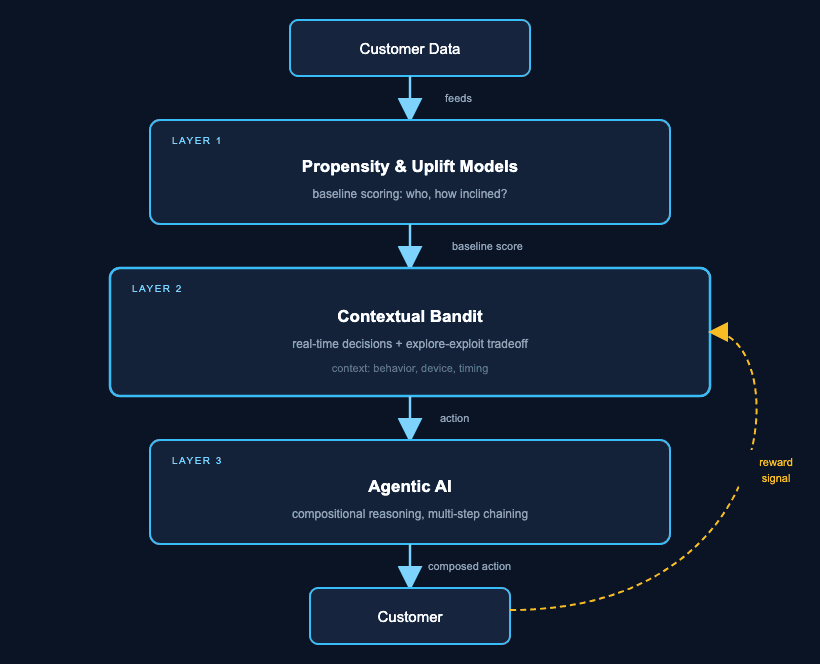
Layer 1: Propensity and uplift models
The first layer does the baseline scoring. Propensity models say “how inclined is this customer toward this action?” Uplift models go further and measure the actual effect: was the customer converting anyway, or did we genuinely make a difference?
This distinction is critical. Sending an offer to someone who would have converted regardless is burning budget. The real gain sits with the group that only acts because of the intervention.
Layer 2: Contextual bandits for real-time decisions
The second layer is a contextual bandit rooted in reinforcement learning. The system sees the customer’s context (behavior, device, timing), picks an action, and soon gets a reward signal: a click, a conversion, an app open.
The bandit’s power is in managing the explore-exploit tradeoff. It keeps tuning between repeating the known high-reward action and trying new options. So the system never locks onto one “winning” offer; it updates live as fresh signals arrive. These are common in tech companies’ recommendation systems today, and increasingly in enterprise marketing.
Layer 3: Agentic AI and compositional reasoning
The third layer is the newest. Foundation-model agents move past selecting a single action to chaining several steps. In a wealth scenario, an AI copilot handles the portfolio review and drafts the next-best-action suggestion, freeing the advisor to focus on the client’s real goals.
You have to think of the three together. A system on propensity scores alone stays static; one leaning only on the bandit drifts from long-term strategy. The value is in the layers feeding each other.
How Does NBA Create Value in Banking?
In Türkiye most banks already use AI across fraud detection, virtual assistants and more. Personalization sits at the center of it. AI-driven systems can offer budgeting advice from spending habits and sense a credit need weeks before the customer notices.
The gains organizations see from NBA don’t come from a single campaign; they come from a continuously learning decisioning layer that gets a little sharper with every new reward signal.

But success hinges largely on data. Real-time decisions need customer signals streaming instantly, models that are observable and retrainable, and a cleanly captured action-reward loop. The real bottleneck in most NBA projects isn’t model accuracy; it’s whether the data feeding the decision shows up on time and reliably.
Where Should You Start?
The move to NBA doesn’t happen in one step. The healthiest path starts narrow: one channel, one measurable action, a clear reward definition. Once the propensity and uplift layer is solid, you add the real-time contextual bandit layer; agentic structures come online as the infrastructure matures.
At GTech, our Symphony Sense and Analytics solutions help banks build this decisioning infrastructure end to end. The right next action only takes on meaning once it sits on the right data foundation.
Sources
CDP.com: Next Best Action
BCG: The Science Behind Next-Best Action Programs
Braze: Contextual Bandits
Backbase: AI in banking 2026
Prepared by: GTech Data Science Team


